Key Takeaways
- 24 deals across 4 US states, built remotely from Tel Aviv since 2020
- First deal was a flip with $50k profit — done without ever visiting the property
- The Cleveland mistake (5 BRRRRs, all eventually exited): wrong market, bad PM, real losses
- Market selection beats deal selection — a mediocre deal in a great market beats a great deal in the wrong one
- Kings Mountain deal #9: 100% other people’s money, $500/month cash flow, zero capital left in
- The team is the investment — every deal that worked had a functional local team behind it
In 2020 I wired $65,000 from my Israeli bank account to a title company in Fayetteville, North Carolina. I had never been to Fayetteville. I didn’t have a US bank account. I barely knew what an ARV was.
The property sold four months later for $150,000. Profit: around $50,000.
That was deal number one.
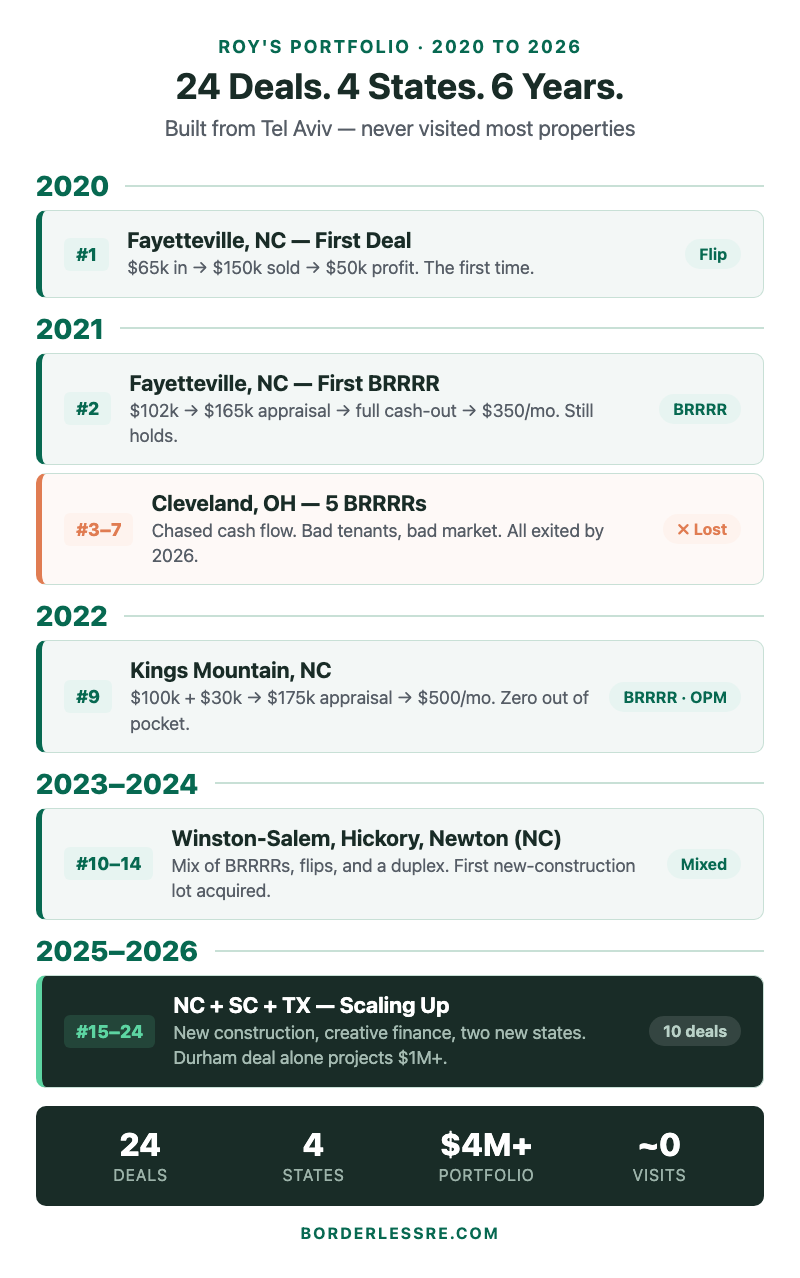
Six years later: 24 deals, 4 states, roughly $4M in portfolio value — and I still haven’t visited most of the properties I own.
This is what that journey actually looked like. The wins and the mistakes. Specifically the Cleveland mistake, which I’ll get to, because it’s the one that cost real money and taught me more than all the wins combined.
2020: The First Deal — Doing Something I Didn’t Fully Understand
My first deal wasn’t a strategy. It was a test.
I had capital sitting in Israel that wasn’t working hard enough. I’d read enough about US real estate to know the fundamentals made sense — prices, rents, and yields that weren’t available in the Israeli market. But I had no idea how to actually do it from where I was.
I found an investor-friendly agent in Fayetteville through a BiggerPockets forum thread. He found a distressed property. I ran the numbers with him over WhatsApp. I wired the money. I hired a local contractor to manage the rehab. I hired an agent to list it when it was done.
$65k purchase. $35k rehab. $150k sale. $50k profit.
It worked. Which was both the best outcome and the most dangerous one — because it made everything feel simpler than it was.
2021: The BRRRR Discovery — and the Cleveland Mistake
The flip profit got recycled into what became my actual strategy: BRRRR. Buy, Rehab, Rent, Refinance, Repeat.
The Fayetteville flip showed me that remote rehab was possible. The BRRRR strategy showed me how to build something that compounded — pull your capital out in a refinance, deploy it again, and own cash-flowing assets with essentially none of your original money still in them.
Deal #2 was the proof of concept: $102,000 purchase, $18,000 rehab, appraised at $165,000 after repairs. A DSCR cash-out refinance at 75% LTV returned all the capital I’d put in. The property has cash flowed $350/month since 2021. I still own it.
Then I made the mistake that nearly everyone makes: I found a market that looked great on paper and scaled into it too fast.
The Cleveland Story
In 2021 I bought 5 properties in Cleveland, Ohio. Deals #3 through #7.
The thesis made sense: low prices, reasonable rents, decent cash flow on paper. I found an agent who worked with investors. I found a property manager. I ran the numbers. The DSCR ratios worked.
What the numbers didn’t show: the quality of tenants in that specific price range, the maintenance costs on older Cleveland housing stock, the pace of property appreciation in a market that wasn’t growing the way I thought it was, and the reality that the PM I’d hired was not the person I needed her to be.
Over the next two years, I had evictions, vacancies, unexpected repairs, and properties that were bleeding cash rather than generating it. The “perfect BRRRR” in that portfolio — deal #6, $88k in, $6k rehab, $146k appraisal — looked great on paper and still got exited when I finally decided Cleveland wasn’t the right long-term market.
By 2026 I’d sold all five Cleveland properties. Some at break-even. Some at a small loss after expenses. The total damage wasn’t catastrophic — but it was real, and it set back the portfolio by the better part of a year.
What I learned: cash flow at the property level is not enough. Market selection is what determines whether you compound or tread water. Cleveland generated income. It didn’t generate equity growth. And when the PM situation deteriorated, the income disappeared too. The right market with a mediocre PM is recoverable. The wrong market with a perfect PM is still the wrong market.
That lesson reshaped everything that came after.
2022–2023: Back to North Carolina, Refined
After Cleveland, I stopped expanding into new markets I hadn’t thoroughly underwritten. I went back to North Carolina — where I had a working team, a market I understood, and a track record of deals that had actually worked.
Two more Fayetteville BRRRRs. Then deal #9 in Kings Mountain, NC — the one that removed any remaining doubt that this model worked.
Kings Mountain: $100,000 purchase, $30,000 rehab, $175,000 appraisal. The entire acquisition and rehab was funded with OPM — other people’s money. A private lender covered the acquisition; hard money covered the rehab. The DSCR refinance paid back both. I walked out of closing with zero of my own capital in the deal and $500/month in cash flow. That property still cash flows today.
In 2023 I moved into Winston-Salem, NC — a market with stronger appreciation characteristics than Fayetteville and a price-to-rent ratio that still worked for BRRRR. Deal #10 went in at $190,000 and appraised at $297,000 after repairs. OPM again. Deal #11 was a flip with a partner — $75k purchase, $67k rehab, $210k sale. The profit from that deal funded deal #12.
2024: Diversifying Strategies
By 2024 I’d closed 11 deals. The portfolio was generating meaningful cash flow. I had a team I trusted in North Carolina and a financing structure that worked.
I started layering in new strategies: a second Winston-Salem flip with a partner, a duplex in Newton, NC that came with an adjacent development lot I didn’t pay separately for. That lot is now under construction — a new build with a projected sale price of $350,000 against $165,000 in construction costs.
The Newton duplex itself (deal #14): $135,000 purchase, $100,000 rehab, $275,000 appraisal, $450/month cash flow. The adjacent lot cost $0 because it came with the deal. That’s the kind of thing that only becomes visible after you’ve looked at enough properties to recognize non-obvious value.
2025–2026: New Construction, Creative Finance, New States
The portfolio has been in a different mode for the last 18 months. Less BRRRR, more construction and creative finance.
Five active new construction projects — from a single-family in Hope Mills, NC (projected $270k sale) to a Durham, NC deal that’s the most complex thing I’ve done. Deal #20: $450,000 acquisition, lot gets subdivided into three parcels, two new builds at approximately $500,000 each. One acquisition becomes potentially $550,000+ in profit.
That’s not something I could have seen in 2020. It took 19 deals to build the pattern recognition to find it.
Deals #23 and #24 — Columbia, SC and San Antonio, TX — were funded by pulling equity from the existing portfolio in a 2026 refinance. $30k and $32k out of pocket respectively, each into properties valued around $280k. Two new states, funded by the portfolio itself.
What the Portfolio Actually Looks Like Now
24 deals. Still running from Tel Aviv.
Active cash-flowing holds: roughly $2,300/month across 6 properties. Active projects under construction or rehab: five builds projecting $2.5M+ in combined sales. Two creative finance deals cash flowing from South Carolina and Texas.
The Cleveland properties are gone. No regret — just a lesson that got applied to everything after.
The full system behind how I select markets, build teams, and structure deals — without ever visiting most of what I buy — is in How to Invest in US Real Estate from Abroad.
What Six Years Taught Me That I Didn’t Know Going In
The team is the investment, not the property. Every deal that worked well had a functional local team behind it. Every deal that struggled had a broken link — usually the PM, sometimes the contractor. The property is a financial instrument. The team is what makes it perform.
Market selection beats deal selection. A mediocre deal in a great market still builds wealth over time. A great deal in the wrong market is a harder-to-exit problem. I spent too long optimizing for the deal and not enough time on the market. Cleveland taught me that.
Scaling before the system is ready is expensive. I went from 1 deal in 2020 to 7 deals in 2021. The Fayetteville system was in place. The Cleveland system wasn’t. I was adding properties faster than I was adding infrastructure. The result was predictable in hindsight.
Other people’s money is a skill, not a shortcut. It took until deal #9 before I deployed 100% OPM. Getting there required a track record of completed deals, working relationships with private lenders, and the judgment to know which deals were worth bringing to someone else’s capital. You earn it — you don’t just ask for it.
The first deal is the hardest. Not because it’s the most complicated — because you don’t believe it’s actually going to happen. After it does, everything changes. The second deal is easier than the first. The tenth is easier than the second. The compounding isn’t just financial — it’s experiential.
If you’re sitting on capital and trying to figure out where you actually stand — on market selection, team building, financing access, and deal structure — the Remote Investor Readiness Score is the honest starting point. It’s what I wish I’d had before Cleveland.
Find out exactly where you stand before your first deal.
10 questions. A personalized score across 5 dimensions. Free.
Get my readiness score →