

Key Takeaways
- Flipping houses remotely is not about being a better project manager. It’s about replacing every shoulder-tap and drive-by with a written system the builder agrees to before the first dollar is spent.
- The seven flips I’ve done from Israel since 2020 share three things: a scope-of-work locked before closing, a draw schedule tied to stages I can verify in photos, and a change-order rule that no surprise above $500 gets paid for without my written sign-off.
- The most expensive part of remote flipping isn’t the rehab — it’s the contractor you pick. A wrong builder costs more than a wrong house. I’ve held the same builder for years across 17 properties for exactly this reason.
- The Newton 2025 flip ran almost exactly to plan: $82k + $38k → $215k. The 2024 Winston-Salem flip didn’t — costs went $20k over budget mid-rehab and I had to decide whether to keep going. Both decisions came down to the system, not the gut.
- If you can’t get on a plane in 48 hours, the way you communicate has to change. The system below is what’s worked across seven flips, four states, and zero on-site visits during rehab — and it works the same whether you’re a US investor flipping out of state or an international investor flipping from abroad.
IN THIS ARTICLE
- How to Flip Houses Remotely Without Stepping on the Property
- The Builder Decision Is the Whole Game
- The Scope of Work That Has to Be Locked Before Closing
- The Weekly Photo Report Replaces Walking the Site
- The Draw Schedule Is How You Pay Without Watching
- The Change Order Rule That Saves Five-Figure Surprises
- What Most People Get Wrong About Remote Renovation Management
- What Happens When It Goes Wrong (Mid-Rehab Crisis Protocol)
- Frequently Asked Questions
How to Flip Houses Remotely Without Stepping on the Property
The honest version of how to flip houses remotely is this: you replace presence with structure. You can’t drive by on Friday afternoon to see how the framing went. You can’t catch the painter cutting corners by walking in mid-coat. So the system has to do what your eyes would have done — and the system is mostly written, mostly agreed to in advance, and mostly enforced by money.
I’ve done seven fix and flips since 2020 from Israel. North Carolina, mostly — Winston-Salem, Newton, Gastonia, Thomasville. I’ve been on the ground for one of those rehabs in person. The other six were managed entirely from a desk in Tel Aviv, on a 7-hour time difference, often with the builder calling me at 3am his time. The flips that worked and the one that almost didn’t taught me the same lesson from opposite sides: the part of the deal you control is the structure around the work, not the work itself.
The framework here works the same whether you live in California and you’re flipping in Cleveland, or you live in Tel Aviv and you’re flipping in North Carolina. The friction of distance is the same in kind — different only in degree. A US investor flipping out of state can still drive to the property if a fire breaks out; an international investor can’t. That’s the only meaningful difference, and the system below is built so the meaningful difference doesn’t actually matter — because nobody should be running a flip on the assumption they can show up in person to fix it.
This post is the actual system. Not “communicate well with your contractor” — the specific Monday photo report, the four-stage draw schedule, the change-order rule that has saved me five-figure surprises, and what I do when something goes wrong mid-rehab. If you’re a US investor looking at out-of-state real estate investing, the system applies directly. If you’re trying to figure out how to invest in US real estate from abroad, the system is the same — you just have an extra setup layer (LLC, ITIN, financing) before you ever get to a flip.
The Builder Decision Is the Whole Game
Before any of the system below matters, the builder decision has to be right. I’ll say this directly: the builder is the most important person in a remote flip, and getting that hire wrong is more expensive than picking the wrong house, the wrong market, or the wrong financing. A bad builder will turn a $40k rehab into a $70k rehab and a six-month project into ten months. A good builder will tell you on day three that the foundation is worse than the inspection caught and save you $30k by stopping early.
I work with the same builder on most of my North Carolina flips and new construction. We’ve done 17 projects together. He knows my deal criteria, knows the markets I buy in, knows how I underwrite. When he tells me a property is worth pursuing, I trust the call because I’ve seen him be right hundreds of times in a row. That relationship is six years old. It didn’t start that way.
The way it started was one project, with a clear scope, a small enough rehab budget that a mistake wouldn’t kill me, and a clean exit on both sides if it didn’t work. That’s the model I’d recommend to anyone starting from zero. Don’t sign a builder to a $200k project on the first try. Give him a $30k rehab. Watch how he communicates when there’s bad news. Watch whether he comes in close to budget. Watch whether the punch list at the end takes one week or six. The data you collect on a small first project tells you everything about whether the second project should happen.
What to look for, specifically: a builder who returns calls within 24 hours when something goes wrong, sends unprompted weekly updates, and gives you a flat answer (“yes that’s possible, no that’s not, here’s what it’ll cost”) instead of vague reassurance. The contractors who manage the most expectations and explain the most variables tend to be the ones who deliver the most predictable outcomes. The ones who tell you everything is fine right up until the moment it isn’t are the ones who cost you money.
The Scope of Work That Has to Be Locked Before Closing
The biggest mistake I made on early flips was treating the scope of work as a directional document. It’s not. On a remote flip the scope of work is the contract — it’s what you’re paying for, what you’re not paying for, and what counts as a change order. If the scope is vague, every disagreement during the rehab gets resolved in the contractor’s favor, because he’s there and you’re not.
What goes in the scope, line by line: every room, every system (plumbing, electrical, HVAC, roof, foundation), every finish (flooring type and brand if it matters, paint color, fixtures by SKU when possible), every demo line item, and every excluded item. The exclusions are as important as the inclusions. “Does not include landscaping beyond clearing and basic seeding.” “Does not include any work on the detached garage.” “Does not include code upgrades discovered during permit pull.” Each excluded line is a $2k–$10k fight you don’t have to have later.
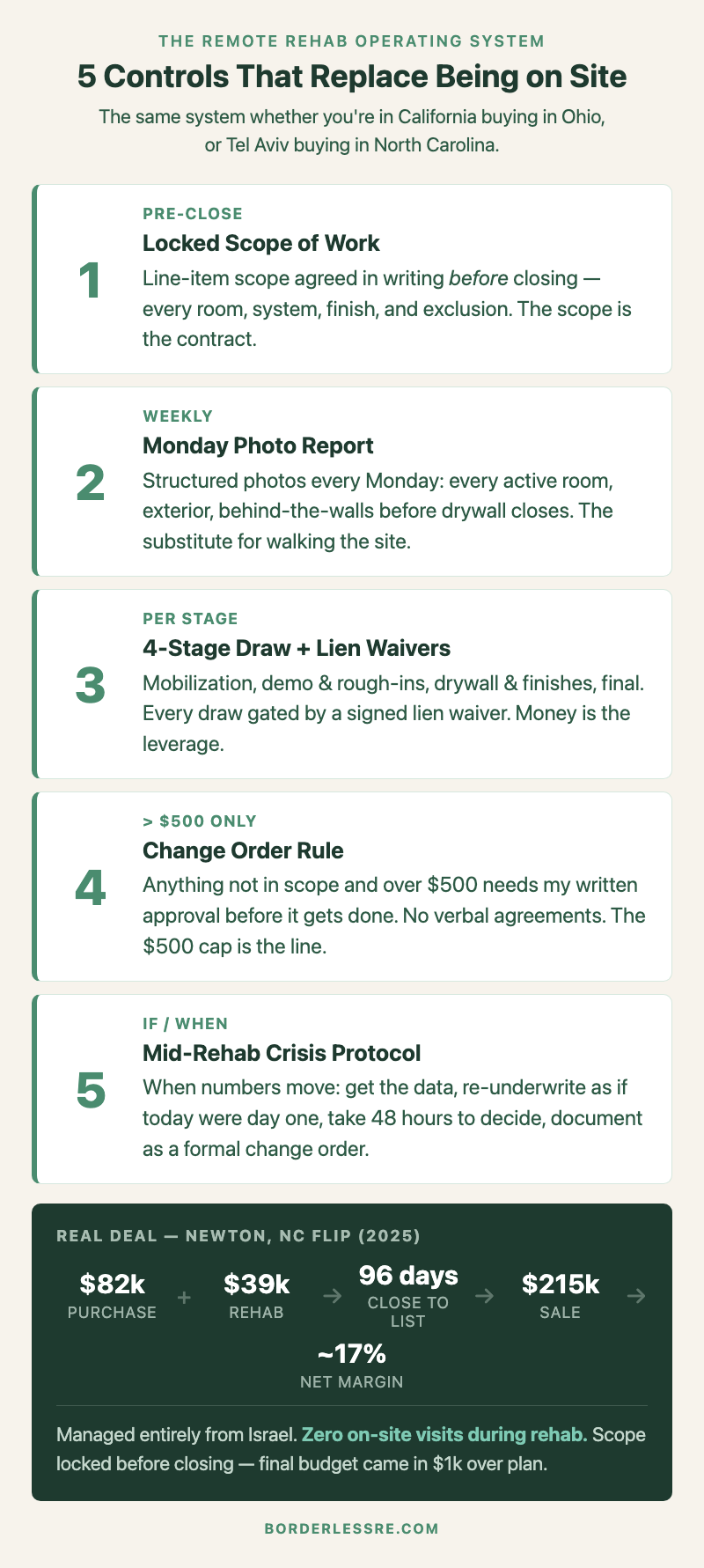
I get the scope drafted by my builder, then I read it twice — once for accuracy, once asking what’s missing. Then I send it back with edits and we agree before closing. On the Newton flip in 2025, the scope was 4 pages and locked the day before we closed. Total project: $82k purchase + $38k rehab + 90 days. We hit $39k actual rehab and 96 days. That’s the closest a flip can get to running on rails — and it ran on rails because there was nothing ambiguous in the scope to renegotiate later.
The flips that ran over budget all had something the scope didn’t address. Winston-Salem 2024 — $150k purchase, $60k projected rehab, came in around $80k because we found foundation issues that weren’t in the scope and couldn’t be ignored. The conversation about who pays for the additional work would have been impossible without the original scope being specific. Because it was specific, the math was simple: foundation work wasn’t in scope, here’s the additional cost, do we proceed or pivot. That’s the conversation you want to be able to have. You can’t have it without a precise scope.
The Weekly Photo Report Replaces Walking the Site
Every Monday, my builder sends a photo report. Not a text update — a structured set of photos: every active room, the exterior, any current trade work in progress, anything that wasn’t there last week, and a one-paragraph note about what’s planned for the upcoming week. It’s not a casual ask. It’s a contract expectation written into how we work together. Across seven flips, I have seen most of my projects only through these reports.
The photos do three things at once. First, they create a paper trail that protects both sides — if something looks different at the end than the photos showed mid-project, there’s a record of when it changed and why. Second, they catch issues early, while they’re cheap to fix. A missing detail in the framing photos in week three is a 30-minute conversation. The same issue caught at the punch list is a $3k callback. Third, they give me the data to decide whether the project is on schedule and on budget — not based on the builder’s optimism, but on what I’m actually seeing.
The photos that matter most are the ones I would have skipped early on. The behind-the-walls photos before drywall closes up. The HVAC ductwork in the attic. The plumbing rough-in. These are the parts that get expensive to revisit later, and they’re the parts a remote investor would never see if the builder didn’t proactively shoot them. The standard now is: anything that’s about to be covered up gets photographed first. Always.
When I want a closer look at something specific, I ask for a video walk-through, usually 5–10 minutes. Builders generally don’t love these because they take time to do well. Mine has accepted that they’re part of the relationship — usually one or two per project, at the moments where the decisions are highest stakes (after demo, before refi appraisal). For out-of-state real estate investing of any kind, this kind of media-driven oversight isn’t optional. It’s the substitute for being there.
The Draw Schedule Is How You Pay Without Watching
Money out of pocket is what gives a remote investor leverage. A contractor paid in full up front has no reason to finish on schedule. A contractor paid only at the end has cash flow problems and will cut corners or delay. The draw schedule is the middle path — it pays the work in stages tied to verifiable milestones, and it keeps both sides aligned on the right pace.
The structure I use on most flips is four draws:
- Mobilization (10–15%) — paid at start, after permit pull and material order. Funds the initial labor and dumpster.
- Demo + rough-ins (25–30%) — paid after demo is complete and the plumbing/electrical/HVAC rough-ins are inspected. Photo evidence required.
- Drywall + finishes underway (30–35%) — paid when drywall is up, painting is in progress, and the project is visibly on track.
- Final (25–30%) — paid at completion of the punch list and final cleaning, after I’ve reviewed the final photos or video walk-through.
Every draw is gated by a lien waiver — the contractor and any subs sign that they’ve been paid for the work covered through that draw and have no claim on the property. This is non-negotiable. A property with unpaid mechanic’s liens at the end of a flip is a property you can’t sell without a fight, and remote investors don’t have the time or the proximity to clean up that kind of problem. The lien waiver protocol is one of the few places where there’s no flexibility in the system.
The draw structure also exposes problems early. If the demo + rough-in stage takes 50% longer than scheduled, that’s a leading indicator that the rest of the project will too. The schedule itself becomes a diagnostic. On the 2024 Winston-Salem flip when we found the foundation issues, the draw schedule made the decision to continue or pull the plug a clean conversation: here’s what we’ve paid, here’s what’s left, here’s what the new total looks like, do the deal economics still work. We continued, and the deal still cleared a profit — but the structure made the decision rational rather than emotional.
The Change Order Rule That Saves Five-Figure Surprises
The most common way a remote flip goes off the rails isn’t a single big disaster. It’s accumulation — small changes during the rehab that each seem reasonable in the moment, then add up at the end to a number that turns the deal into a break-even or a loss. The fix is simple: anything not in the original scope, anything that costs more than $500, doesn’t get done without my written approval.
The mechanism is a change order. The builder describes the issue, the proposed fix, and the cost. I either approve it or counter-propose. We document it in writing — usually a short email or a signed change order form — and it gets added to the scope. The cost goes to me, not buried in the next draw. The cap is set at $500 because anything below that creates more friction than it saves; the cap is the line between “running the project” and “renegotiating the project.” Builders who can’t operate above this line tend not to last long working with me.
The rule also works in the other direction. If something can be removed from the scope (a finish that’s now unavailable, a system that turned out to be in better shape than expected), the savings flow back to me. This part is usually undocumented in builder relationships — savings get absorbed into the next line item without the investor knowing. The change-order rule makes the savings visible and accountable.
What this prevents, in practice: the $4k “we found we needed to upgrade the breaker box” call that turns into a $6k actual cost. The “we redid the master bath tile because it didn’t match the floor” decision that adds $2k to a budget. The $1,800 patio that wasn’t in scope but the contractor added because “you’d want it for resale.” Every one of those is a real example from someone else’s flip. The change-order rule is the single most expensive lesson to learn the hard way and the cheapest one to install up front.
What Most People Get Wrong About Remote Renovation Management
The conventional advice on remote rehab management is mostly about communication tools — Slack channels, project management software, weekly Zoom calls. Most of that is noise. The communication infrastructure isn’t the problem. The structure of the agreement is.
What people get wrong, in order:
They start with a great communication tool and a vague contract. This is backwards. The contract is the leverage; the communication tool is the convenience. A weekly Zoom call doesn’t help if the scope of work was a one-page document and the change-order rule doesn’t exist. I’d take a builder who emails me twice a month with airtight scopes and draws over a builder who hops on Slack daily but operates on a handshake. The data flow is secondary to the structure.
They underprice the cost of vetting. Time spent vetting a builder is the highest-leverage time on a flip. Most investors spend more time analyzing the deal than vetting the contractor. That ratio should be reversed for the first project, especially. A property is just numbers — they’re either there or they’re not. A builder is character, communication style, and operational discipline, none of which show up in a single conversation. Two months of vetting saves two years of regret.
They treat the scope of work as a future concern. Half the budget overrun problems on remote flips happen because the scope was written after the closing instead of before it. The leverage to negotiate scope is highest before money changes hands. After closing, the builder has the project and you have less negotiating power than you think. If a builder can’t or won’t write a detailed scope before closing, that’s the entire information you need about whether to work with him.
The single biggest unlock on flipping remotely is the realization that the rehab is a structured business transaction, not a craftsmanship relationship. Treat it like a business deal — written, specific, accountable — and it works. Treat it like trust between friends and the friction of distance will compound every weakness in the agreement.
What Happens When It Goes Wrong (Mid-Rehab Crisis Protocol)
It will go wrong on at least one project. The right question isn’t whether but what you do when it does. The Winston-Salem 2024 flip is the case study I use for myself — it’s the deal that taught me the most about staying calm and trusting the system when the numbers move on you.
Six weeks into the rehab, my builder called: foundation problems weren’t visible during inspection but were now obvious with the floors up. Repair would add roughly $20k to the budget. We were already at $200k all-in projected; this would push us to $220k against an after-repair value still expected around $300k. The deal was tighter but not dead.
The protocol I followed, which I’d recommend to anyone in the same position:
- Get the data, not the recommendation. I asked for the actual repair scope, multiple bids, and the timeline impact. I didn’t ask “should we keep going?” because that’s the wrong question for the builder to answer.
- Re-underwrite the deal as if today were day one. With the new total cost, did the deal still meet my profit threshold (typically 15–20% on flips)? If yes, continue. If no, pivot.
- Decide on a written timeline, not a phone call. I gave myself 48 hours to make the call so I wouldn’t decide reactively. The 48-hour window is partly tactical — emotional decisions made at 3am in a different time zone tend to be worse than the same decisions made the next day with sleep.
- Document the change as a formal change order. No verbal agreements. The new scope, new cost, new timeline went into a written document we both signed.
The deal went forward, sold for $300k, and produced a smaller profit than originally underwritten — but a profit. The same structure that made the original budget run cleanly is what made the recovery possible. There was no improvising under pressure because the framework was already in place.
Frequently Asked Questions
How do you find contractors remotely if you’ve never met them?
The same way you find a good property manager remotely — referrals, then verification. The first contractor I worked with came through my real estate agent. The second came through the first. Most of my builders since have come through other investors in the same market who had worked with them on completed projects. Cold-calling contractors from Google reviews is the worst path. Network into them through people who have already paid them. The verification step is non-negotiable. Before any project, I ask for three references from completed work in the last 12 months. I call all three. I also pull permits in the contractor’s name from the county website (most NC counties make this public) to see what they’ve been working on at what scale. A contractor whose biggest recent project is half the size of yours is a risk; a contractor with a clean permit history at your project’s scale is a much safer hire.
Can you flip a house without ever visiting it?
Yes — six of the seven flips I’ve done were managed without a physical visit during rehab. The condition is that the builder, the agent, and the photo/video flow are good enough to substitute for being there. If any of those three is weak, the answer changes. The first flip is the riskiest one to do this way; consider visiting the first project once or twice if you can.
What’s the typical profit margin on a remote fix and flip?
In my experience, target 15–20% net profit on the all-in cost (purchase + rehab + holding costs + selling costs). On the Newton 2025 flip: $82k purchase + $38k rehab + ~$8k holding + ~$13k selling costs = ~$141k all-in, sold at $215k = $74k gross / about 17% net after holding costs. That’s roughly the model — projects at 10% are too thin to absorb a budget surprise, and projects above 25% on paper usually have something the underwriting missed.
How long does a typical remote flip take?
Plan for 4–6 months from closing to listing on a standard cosmetic-to-mid rehab. Add 2–3 months for full system replacement projects (HVAC, electrical, plumbing). The Newton 2025 flip ran 96 days from closing to list. The 2024 Winston-Salem flip ran 7 months because of the foundation work. Local flippers can sometimes turn projects in 90 days; remote flippers should add a buffer because every issue takes one extra business day to resolve when you’re working across time zones.
What’s the biggest hidden cost of flipping remotely?
Holding costs during delays. Every extra month of carry on a $150k flip with a hard money loan at 11% is around $1,400 in interest plus utilities, insurance, and taxes. A two-month delay on a tight deal can erase the margin. The system above exists primarily to compress timelines — fewer delays, fewer change orders, fewer surprises — because the math of remote flipping is much more sensitive to time than to any single line item.
Is flipping or BRRRR better for remote investors?
Different problems. Flipping is a project business — every deal is a discrete transaction with a clear exit. BRRRR is an asset-building business — every deal is a long-term hold that produces equity and cash flow over years. Remote flipping has higher per-deal upside and higher per-deal risk; remote BRRRR has lower per-deal cash but compounds. I do both. The blueprint for the long-term hold approach is in the long distance real estate investing breakdown.
So how do you flip houses remotely? Not by being a better project manager. By replacing the things you can’t do — drop by the site, eyeball the framing, catch a problem in person — with structure that does the same job in writing. A locked scope, a Monday photo report, a four-stage draw schedule, a change-order rule above $500, and a builder you’ve vetted hard enough to trust without supervision. That’s seven flips’ worth of system, distilled into a list short enough to actually use — whether you’re a US investor flipping out of state or an international investor flipping from abroad.
If you’re trying to figure out where you stand before your first remote project — whether it’s a flip, a BRRRR, or anything else — I built the Remote Investor Readiness Score for exactly that question. Ten questions, five dimensions (capital, market, team, financing, legal), and a personalized report on what’s strong and what’s missing. The Team Setup dimension is the one most relevant to flipping remotely; if it scores low, the post above is the first thing you should fix. No course pitch. No upsell. Just the score and the next step.
Find out exactly where you stand before your first deal.
10 questions. A personalized score across 5 dimensions. Free.
Get my readiness score →