
Key Takeaways
- You don’t need to visit a market to research it. I own in four states and have visited two of those markets, once each, after I’d already bought. A repeatable desk process beats a plane ticket.
- Remote market research is a 5-stage funnel: macro data → neighborhood data → rent comps → law and tax → one local call. Each stage is a filter built to kill bad markets fast.
- Stage one takes five minutes and kills most markets. If population and job growth aren’t trending up, you stop — there’s no point researching anything else.
- Every number gets pulled from 2–3 free sources, and you take the conservative figure. One pretty number from one tool is not research.
- The data gets you 90% of the way. The last 10% is a 30-minute call with a local agent or property manager to confirm what a spreadsheet can’t show — which is also how you start building your team.
IN THIS ARTICLE
- Researching a Market From 7,000 Miles Away
- How to Research Real Estate Markets Remotely: A 5-Stage Funnel
- Stage 1 — Macro Data: Is This Market Even Worth an Hour of Your Time?
- Stage 2 — Neighborhood Data: From City Down to Street
- Stage 3 — Rent Comps: What the Property Will Actually Earn
- Stage 4 — The Law and Tax Check
- Stage 5 — The Call That Confirms (or Kills) the Data
- What Most People Get Wrong About Remote Market Research
- Frequently Asked Questions
Researching a Market From 7,000 Miles Away
I’ve researched fifteen real estate markets I never set foot in. I own properties in four states, and I’ve visited maybe two of those markets — once each, years after I’d already bought.
That’s not recklessness. It’s a process. Researching a market you can’t drive to isn’t about a plane ticket or a gut feeling — it’s a repeatable desk process that takes a few hours and uses data anyone can pull for free.
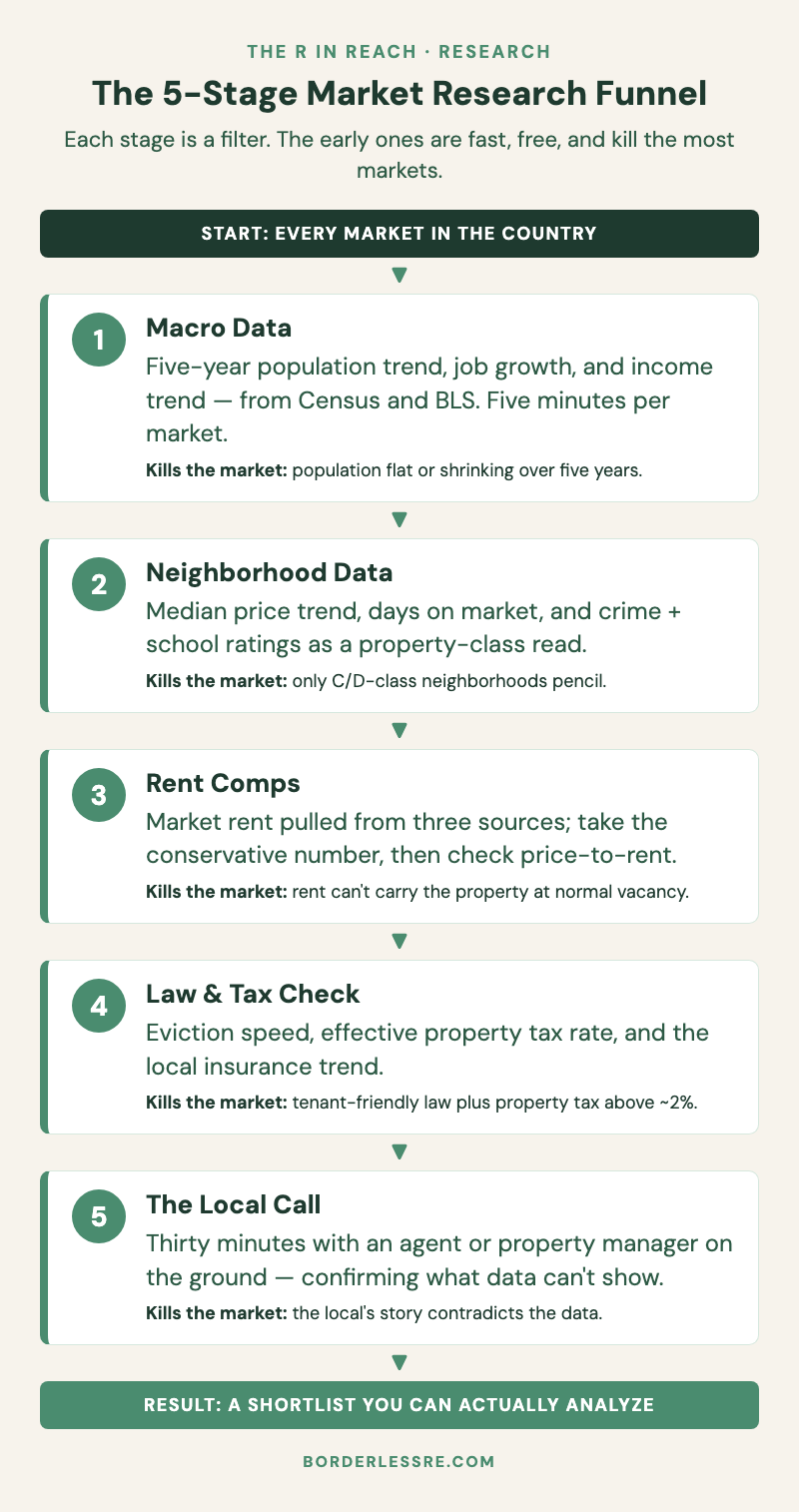
This is how to research real estate markets remotely: a five-stage funnel that starts with the whole country and ends with one phone call. Each stage is a filter. Most markets die at stage one, which is exactly the point — the job of research is to kill bad markets fast, before you waste a week analyzing properties in a place you should never have considered.
How to Research Real Estate Markets Remotely: A 5-Stage Funnel
Research has one job: kill bad markets before they cost you time. Not confirm a market you already like — kill the ones that don’t deserve a second look. A funnel does that. You start wide, with every market in the country on the table, and each stage filters out the ones that fail. What’s left at the end is a short list you can actually analyze properties in.
The five stages, in order: macro data, neighborhood data, rent comps, the law and tax check, and one call with someone on the ground. The order matters. The early stages are fast and free and kill the most markets. The later stages take more effort — so you only spend that effort on markets that have already earned it.
This is the R in REACH — Research — the first step of the framework behind every deal I’ve done. It’s also the engine that feeds the six-criteria market screen: the funnel is how you gather the data to actually score a market.
Stage 1 — Macro Data: Is This Market Even Worth an Hour of Your Time?
Stage one is a five-minute test, and most markets fail it. You’re answering one question: is this market growing? If it isn’t, nothing else matters, and you stop here.
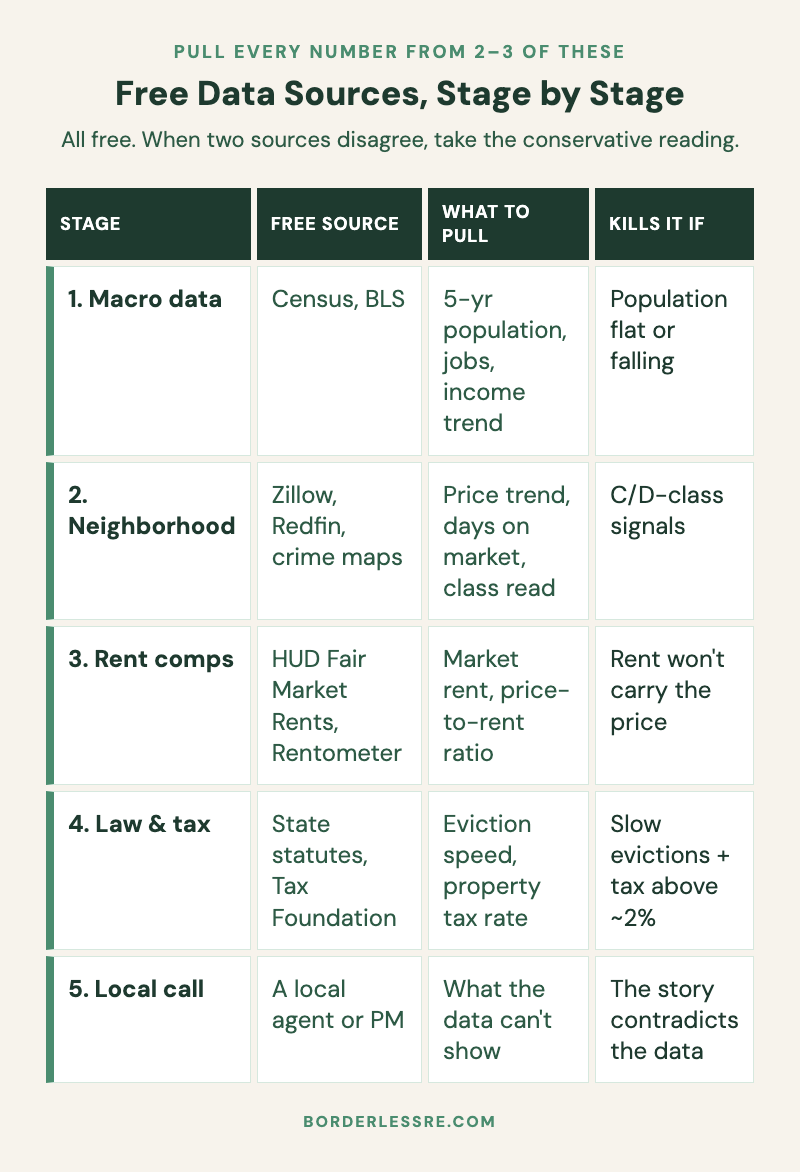
Two free government sources answer it. The US Census Bureau’s population estimates give you population by metro and county, updated every year. The Bureau of Labor Statistics’ local area unemployment data gives you the job picture. Open both.
Three numbers, pulled in this order:
- Five-year population trend. Not one year — five. You want steady, year-over-year growth. Flat or declining population is an automatic kill.
- Job growth and unemployment. Is the metro adding jobs, and is unemployment at or below the national average? A market with one big employer and nothing else is fragile, even when the headline number looks fine.
- Median household income trend. Rising incomes mean rising rents over time. Flat incomes cap your rent growth no matter what you do to the property.
The red-flag thresholds: population flat or negative over five years — kill it. Unemployment well above the national rate — kill it. A single-industry economy — at minimum, a serious flag.
This is the stage that would have saved me in Cleveland. The population trend was right there, free, on a government website. I just never looked, because the property numbers were exciting and the market numbers weren’t. A market that fails stage one is exactly the kind of place that later makes people wonder whether out-of-state investing is worth it at all — when the real problem was a research step that got skipped.
Stage 2 — Neighborhood Data: From City Down to Street
A market that clears stage one isn’t one place — it’s dozens of neighborhoods, and they are not the same investment. A growing metro can have streets you’d never want a tenant on. Stage two zooms from the city down to the neighborhood.
The tools here are the listing sites — Zillow, Redfin — plus public crime maps and school-rating sites. You’re not shopping for a property yet. You’re reading the neighborhood. Three numbers:
- Median price trend by ZIP or neighborhood. Is this specific area appreciating with the metro, or quietly lagging it?
- Days on market. How fast do homes sell here? Days on market rising while the metro’s holds flat is an early warning the area is softening.
- A neighborhood-class read. Crime data and school ratings together are a decent proxy for property class. You’re trying to confirm this is B-class — a stable working neighborhood a property manager can keep full from a distance.
Red flags: days on market climbing against a flat metro; crime and school signals that point to C or D class. C and D neighborhoods can show tempting numbers, but they punish remote investors specifically — turnover and maintenance you can’t see and can’t easily fix. Stage two is where you confirm the market’s B-class core is real, not just the metro’s growth headline.
Stage 3 — Rent Comps: What the Property Will Actually Earn
Stages one and two told you the market is growing and the neighborhood is stable. Stage three tells you what a property there will actually rent for — the number every cash-flow projection is built on, and the one beginners most often get wrong by being optimistic.
Start with the HUD Fair Market Rent data — it’s free, government-published, and gives you a defensible baseline rent by bedroom count for every county. Then cross-check it against active rental listings on Zillow and a tool like Rentometer. You’re pulling the market rent for the typical property you’d buy — say, a 3-bed, 2-bath — from three independent sources.
Then the discipline: take the conservative number, not the average and definitely not the high one. If HUD says $1,200, Zillow listings say $1,300, and Rentometer says $1,250, you underwrite at $1,200. With the rent figure in hand, you can calculate the price-to-rent ratio for the neighborhood and see whether the cash-flow math is structurally possible — before you ever analyze a specific listing.
The red flag: a price-to-rent ratio where the rent can’t cover the property at a normal vacancy rate. If the math doesn’t work at the market level, it won’t work on a single deal. Move on.
Stage 4 — The Law and Tax Check
Two markets with identical rents and prices can deliver very different returns, because the state you’re in decides how much a bad tenant — and the government — can cost you. Stage four is the legal and tax read.
Three things to check:
- Landlord-tenant law. How long does an eviction take, and how predictable is it? A landlord-friendly state resolves a bad tenancy in weeks. A tenant-friendly one can take months. Read a current summary of the state’s eviction process.
- Property tax. The Tax Foundation’s property tax data gives effective rates by state and county. They range from under 0.3% to well over 2% — and that spread is real money off your cash flow every single month.
- Insurance trend. Harder to pull from a desk. Note whether the market sits in a region with fast-rising premiums — coastal, wildfire, or severe-storm exposure — and flag it for the stage-five call.
Red flags: a tenant-friendly state with a slow eviction process; an effective property tax rate above roughly 2%; a market where insurance is climbing fast enough to erode the margin. No single one of these is automatically disqualifying — but two of them together usually is.
Stage 5 — The Call That Confirms (or Kills) the Data
Four stages of data get you about 90% of the way. The last 10% is a 30-minute phone call with a local real estate agent or property manager — and it’s the most important half hour in the whole process.
Data has blind spots. It can’t tell you that the “growing” metro’s growth is all on the other side of town from where the deals are. It can’t tell you which side of a specific street flips from B-class to C-class. It can’t give you a real insurance quote. It can’t tell you what tenants in that neighborhood are actually like to manage. A local who works that market every day can tell you all of it in half an hour.
The questions I ask on that call:
- Which neighborhoods would you buy in yourself, and which would you avoid completely?
- What does a 3-bed, 2-bath actually rent for in those neighborhoods right now?
- How long is a typical eviction here, start to finish?
- What’s happening with insurance premiums?
- What’s the one thing about this market that surprises out-of-state investors?
If the call confirms the data, the market makes your shortlist. If it contradicts the data — and sometimes it will — you believe the person on the ground over the spreadsheet. That call is also the first brick in your local team: the agent or PM who handles this conversation well is someone you may end up working with for years.
What Most People Get Wrong About Remote Market Research
Two mistakes, and I’ve made both.
The first: researching to confirm instead of to kill. Most people don’t research a market — they fall for one. A city they vacationed in, a market a podcast hyped, a place where houses are cheap enough to feel safe. Then they “research,” and what they’re really doing is collecting evidence for a decision they already made. Real research is adversarial. You run the funnel trying to kill the market. The ones that survive an honest attempt to kill them are the ones worth your money.
The second: trusting one number from one source. One tool’s “market temperature” score, one listicle’s ranking, one Zillow estimate. Every number in this process should come from two or three sources, and when they disagree, you take the conservative one. A single pretty number isn’t research — it’s a guess with a citation.
And the one that feels like research but isn’t: the site visit. Flying out feels diligent. But a one-day visit tells you less than two hours of data and one good call. You walk a clean street on a sunny Tuesday, you feel confident, and you’ve learned almost nothing measurable. Visit a market if you want — but visit after the data has already qualified it, not instead of the data. The plane ticket is not the research.
Frequently Asked Questions
How long does it take to research a real estate market remotely?
Once you know the process, a few hours per market — and stage one takes five minutes. The funnel is built to be fast on purpose: you spend real time only on markets that have already survived the cheap, quick filters. The first market is slower because you’re learning where the data lives. By the third, it’s quick.
Can you really choose a real estate market without visiting it?
Yes. I own properties in four states and have visited two of those markets, once each, only after I’d already bought. Population data, neighborhood data, rent comps, and a call with a local tell you more that’s measurable than a one-day visit ever will. A visit is optional confirmation, not the research itself.
What’s the best tool for real estate market research?
There isn’t one. The point is to triangulate: the Census Bureau and Bureau of Labor Statistics for macro growth, Zillow and Redfin for neighborhood-level price and demand, HUD Fair Market Rents for a defensible rent baseline. Any single tool has blind spots. Using several and taking the conservative reading is the method.
What should I research first about a market?
Population and job growth. If a market isn’t growing, stop — don’t research anything else. It’s the cheapest filter and it kills the most markets. Neighborhoods, rents, law, and taxes only matter in a market that passed the growth test first.
How do I research a neighborhood I’ve never seen?
Stage two of the funnel: pull the median price trend for the ZIP, the days-on-market figure, and a read on crime and school ratings as a proxy for property class. That gets you a reliable picture of whether it’s a stable B-class area. Then confirm it on a call with a local agent who can tell you what the maps can’t.
Is the price-to-rent ratio enough to judge a market?
No. Price-to-rent tells you whether cash flow is structurally possible — it’s necessary, but it’s one number among several. A great ratio in a market with no population growth, or in a C-class neighborhood, is a trap. Use it inside the funnel, not as the funnel.
Researching a market you’ll never stand in isn’t a leap of faith. It’s a funnel. Macro data kills the markets that aren’t growing. Neighborhood data kills the streets you can’t manage. Rent comps kill the math that doesn’t work. The law and tax check kills the states that quietly eat your margin. And one call confirms what’s left. Most markets die in the first five minutes — and that’s the funnel doing its job.
Run it honestly and you’ll end up with a short list of markets you understand better than some people understand the city they live in. From there, the rest of the long distance real estate investing process — building the team, analyzing deals, closing remotely — has somewhere solid to stand.
If you want to know whether market research is currently a strength or a gap for you, the Remote Investor Readiness Score measures exactly that. Ten questions, five dimensions — one of them is Market & Deal Knowledge. It’ll tell you where you stand, and which step to work on next.
Find out exactly where you stand before your first deal.
10 questions. A personalized score across 5 dimensions. Free.
Get my readiness score →