
Introduction: The $150K Bet That Changed My Life
When I first read Rich Dad Poor Dad at 21, it felt like a lightbulb moment — I had found my goal: generate passive income through real estate.
Like many readers, I imagined a future of rental checks arriving while I relaxed on a beach. It took me nearly a decade to realize that dream wasn’t quite what it seemed (I’ll share more on that in another post). But by the time I turned 30, I had saved up $150K and was ready to stop dreaming and start doing.
There was just one problem: I live in Israel, and investing here made zero sense.
Property prices were sky-high, yields were painfully low, and banks offered limited leverage — not exactly the recipe for financial freedom. I started looking abroad, and the U.S. stood out as the perfect market: lower entry costs, solid cash flow, and accessible financing. So I made a decision that would change my life — I started investing in U.S. real estate without ever setting foot in the country.
Remote real estate investing is not where most beginners would start. I had no experience, no real estate background, and no connections. Just capital, conviction, and a willingness to learn by doing. That mindset helped me move fast while others got stuck in analysis paralysis — though it also meant I made more than a few mistakes along the way.
Fast forward five years, and I’ve built a $4 million rental portfolio using only my initial $150K investment — all while working a full-time job and managing everything remotely. If you’re thinking how to start real estate investing, this is the post for you.
Here’s how my capital contributions and portfolio value have grown since 2020:
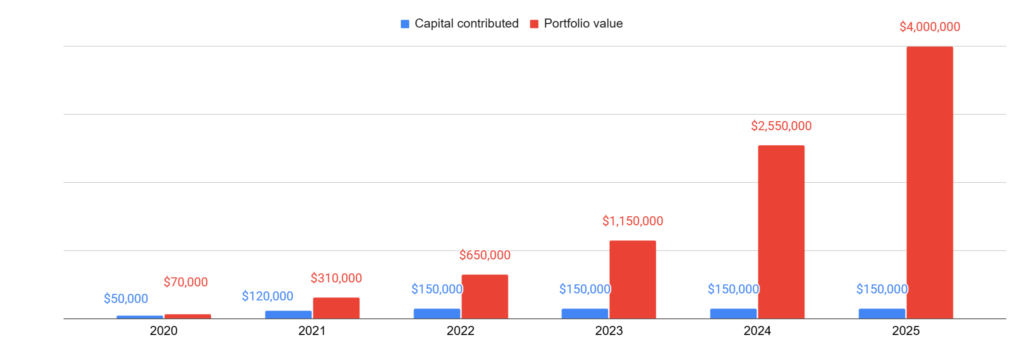
As you can see, the returns didn’t come all at once — but each decision built on the last, creating a snowball effect that I’ll break down year by year below.
This post is for anyone who wants to learn how to invest in real estate but feels stuck by the limitations of their local market — whether that’s a high-cost U.S. city or a completely different country. I’ll walk you through exactly how I built my portfolio, year by year, deal by deal, and share the biggest lessons I learned along the way.
Year 1: 2020 – Starting With a Flip in Fayetteville
My journey began with a flip in Fayetteville, North Carolina — a market I’d never visited, in the middle of a pandemic, during one of the most uncertain times for real estate in recent memory.
I partnered with a friend, and we each put in $50K, giving us a total of $100K to work with. We found the deal through a mutual contact — a childhood friend who lived in Fayetteville and operated as a kind of one-stop-shop: he sourced the deal, handled the rehab, and coordinated the sale. For two first-time, long-distance investors, this setup offered something even more valuable than ROI: trust and simplicity.
🛠 The Deal
- Purchase & rehab budget: $100K total
- Target resale price: $140K
- Actual resale price: $150K
- Exit strategy: Flip
- Role: Passive partner with oversight on budget and scope
I still have the original sensitivity analysis spreadsheet we used to gauge feasibility — built more on optimism and gut feel than deep market data. But the numbers worked, and the margins were there.
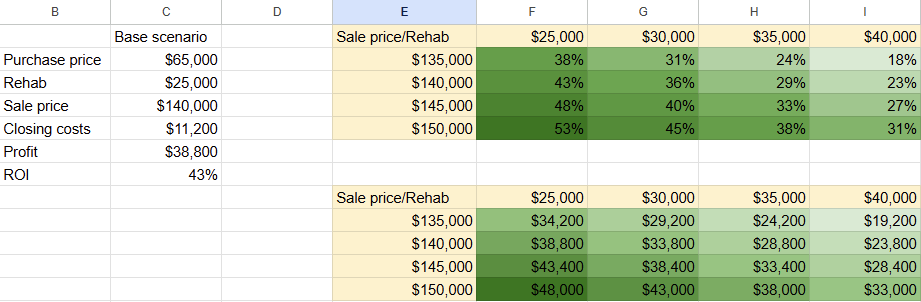
We wanted a hands-off experience, and having one person we trusted on the ground allowed us to stay lean, focused, and calm — even as COVID hit and panic started spreading across the market. If you want to start your remote real estate investing journey with flips, read my master guide on house flipping here.
😰 The Fear Factor
When we were getting ready to close, COVID had just gone global. News headlines were screaming about an impending housing crash. People were backing out of deals left and right.
But I’ve always been action-oriented. I figured: even if prices fall, we’re all in for $100K on a house worth $140K. Worst case, we rent it out and break even.
Instead, the opposite happened. Not only did prices not collapse — they jumped. We sold the property for $150K, a full $10K over our original projection.
🧠 What I Learned in Year 1:
- Trust and speed matter more than perfection. Working with someone I knew gave me the confidence to move quickly.
- Remote real estate investing is real. This deal proved we could flip and profit without ever visiting the property.
- Fear is part of the game. But inaction is often riskier than taking a calculated bet.
Most importantly, this deal gave me something more valuable than a financial return: confidence.
🗓 Year 2: 2021 – Discovering BRRRR and Expanding into New Markets
After the success of our 2020 flip, I reinvested the profits — and added new savings — to transition from flipping to holding. That’s when I discovered the BRRRR strategy (Buy, Rehab, Rent, Refinance, Repeat), and it became my obsession.
It was the perfect fit: build equity fast, recycle your capital, and grow a portfolio without needing hundreds of thousands sitting idle. I also became comfortable with the idea of remote real estate investing. The only challenge? COVID had made deals in North Carolina scarce — especially in Fayetteville, where competition surged and distressed inventory vanished.
That’s when I turned my attention to Cleveland, Ohio.
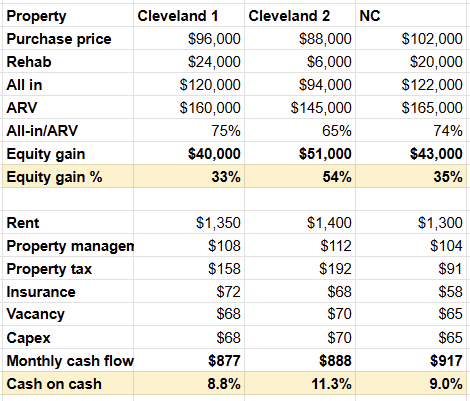
We noticed a lot of activity in the Cleveland market, and unlike many other metros, it still had value-add properties with strong cash flow. The numbers were compelling: I could still find homes at 25%–35% below market value and achieve cash-on-cash returns of 9–11%. It felt like finding gold when everyone else was buying at retail.
🏘 The 2021 Portfolio Moves
That year, I added three single-family homes to my portfolio:
- 2 properties in Cleveland, both purchased with a partner
- All-in: $96K and $120K respectively
- All-in: $96K and $120K respectively
- 1 property in Fayetteville, purchased solo for $122K
All three were classic 3-bedroom, 2-bathroom homes — solid rental stock for working families.
🤝 Building My Team From Scratch
Moving into Cleveland meant starting from zero. We didn’t have boots on the ground, so we began networking online — cold messaging people on Facebook groups and BiggerPockets, vetting agents and contractors one call at a time. Eventually, we landed a realtor, a contractor, and a property manager we trusted. Whenever you put together a plan on how to start real estate investing, building a team should be one of your main priorities.
This was the first time I had to intentionally build a remote team, and I realized:
You don’t need to know people in a market to succeed — you just need a process to find the right people.
💰 The Power of the BRRRR Model
At that time, property prices were still relatively low, and interest rates were historically cheap. That combination allowed us to pull out most of our capital during the refinance step — and still cash flow around $300/month per property.
For the first time, it felt like I had cracked the code:
- I was building equity fast
- I was earning monthly income
- And I was doing it all from another continent, without ever seeing the properties in person
🧠 What I Learned in Year 2:
- BRRRR is real — but only when the numbers and the team are solid
- Market matters. Cleveland worked because we matched the strategy to the market’s inventory and price points
- You can scale with intention — by reinvesting wisely and building a system, not chasing shiny objects
This was the year I stopped being a one-time investor and started becoming a portfolio builder.
🗓 Year 3: 2022 – Scaling Up, Hard Money, and a Hard Truth
By 2022, I felt like I was hitting my stride. I had five rental properties, a growing network, and a clear playbook: use BRRRR to build equity and recycle capital. I was no longer just waiting for deals to come to me — I was actively building relationships, especially with wholesalers.
That year, I bought two more properties — one in Fayetteville, and another in Kings Mountain, NC. Both were solid BRRRR deals that I planned to hold long-term. But how I sourced and financed them — and what I learned from them — fundamentally changed how I thought about wealth-building.
🤝 From Passive Buyer to Trusted Operator
These deals didn’t come from agents or MLS listings — they came from wholesalers. Not just one, but two different wholesalers in two different markets. By now, I had learned that good wholesalers aren’t just lead sources — they’re business partners. And like any good partner, they want to work with people who respect their time.
I made it a rule: respond to every deal they send. Even if it’s a no, explain why.
This created goodwill — and eventually, preference. I started seeing better deals come my way, often before others did.
💸 Leveraging Hard Money
To scale faster and reduce the amount of capital locked into each deal, I started using hard money loans for the initial purchase and rehab. Yes, the rates were higher — but the leverage allowed me to work on multiple deals at once, which I couldn’t have done using only my own cash.
Both properties were classic BRRRR rentals, and they performed well on paper. I successfully refinanced out most of the invested capital, and both generated positive monthly cash flow.
📉 The Reality Check: Cash Flow Isn’t Wealth
But by the end of 2022, I hit a wall.
Despite owning seven rental units and seeing positive numbers on spreadsheets, my actual path to financial freedom felt slower than expected. Why? Because real life eats spreadsheets for breakfast.
- One hot water tank broke
- One property had longer-than-expected vacancy
- Maintenance and management ate into margins
Suddenly, my expected “$1,500/month in cash flow” felt more like $700/month net. And that’s when I had a realization that reshaped everything:
💡 Cash flow pays your bills — but appreciation builds your net worth.
📈 The 2021 vs 2022 Lesson: Follow the Equity
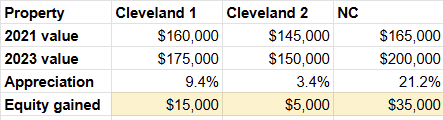
I ran the numbers on one of my 2021 properties — a BRRRR in Fayetteville I had bought for $122K. It had appreciated 21% in just over a year, adding roughly $35,000 in net worth.
Compare that to the annual rental income of ~$3,000–$4,000 after expenses. That single appreciation bump was equivalent to 8–10 years of cash flow from that property.
That changed everything for me.
🧠 What I Learned in Year 3:
- Cash flow matters — but it’s not enough.
- Equity growth through appreciation is the real engine of wealth.
- Respect builds your network. Take wholesalers seriously, and they’ll prioritize you.
- Leverage is a tool, not a crutch. Used right, hard money can accelerate your growth.
From this point forward, I knew 2023 would be about targeting appreciation markets, even if it meant slightly lower yield on paper.
🗓 Year 4: 2023 – Adapting to a Shifting Market
By 2023, the real estate investing landscape had changed dramatically.
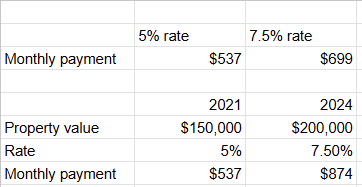
Interest rates had skyrocketed, home prices were still climbing, and the math that made BRRRR deals work so well in 2020–2021 was suddenly upside down. Deals that used to cash flow on paper were now losing $300–$400/month due to higher mortgage payments.
For many investors, this was the moment they hit pause.
But I didn’t want to stop growing — I just had to adapt.
📈 Targeting Growth Markets: My First Deal in Winston-Salem
Up to this point, I had been mostly focused on cash flow and value-add plays. But after learning the power of appreciation in 2022, I began to analyze markets differently.
I compared population growth and home price appreciation across the cities I had already invested in — Cleveland, Fayetteville, and Winston-Salem. The data was clear: Winston-Salem had strong population growth, which tends to correlate with long-term price appreciation.
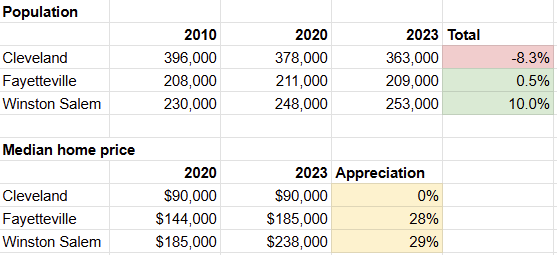
So I bought a rental in Winston-Salem that appraised at $300K. Instead of maxing out leverage, I made a deliberate choice: I borrowed only 60% LTV to ensure I stayed cash flow positive despite high rates.
💡 This was the year I stopped optimizing for leverage, and started optimizing for stability.
💸 Still Hunting for Value: A Return to Fayetteville
At the same time, I didn’t want to completely abandon the BRRRR model. I still believed it worked — if the numbers were right. I found another value-add deal in Fayetteville, all-in for $100K, and refinanced at 70% LTV.
The rent was strong enough to cash flow even after the refi, and it gave me a hybrid win: cash flow + equity.
In a tight rate environment, low price points and modest leverage are what keep the engine running.
🧠 What I Learned in Year 4:
- What worked in 2021 won’t work in 2023. You have to evolve or get left behind.
- Leverage is a double-edged sword. In high-rate environments, it can kill your cash flow.
- Appreciation starts with population growth. Data-driven market selection matters more than ever.
- There’s no single strategy that works every year. Flexibility is the ultimate skill.
2023 tested my ability to adapt — and it taught me to stop relying on just one formula.
🗓 Year 5: 2024–2025 – Creative Deals, New Construction, and the Equity Flywheel
By 2024, it was clear that BRRRR wasn’t the same beast it used to be. With high interest rates and elevated home prices, the classic formula only worked in lower-cost markets — and those didn’t always align with my new focus on appreciation potential.
So I shifted gears once again, leaning hard into creative deals with built-in upside and staying open to any opportunity that made sense.
💡 From Structured Strategy to Opportunistic Execution
This year, I did it all:
- One small rental I bought for $120K that appraised at $190K — allowing me to pull out all of my capital and still end up slightly cash flow positive.
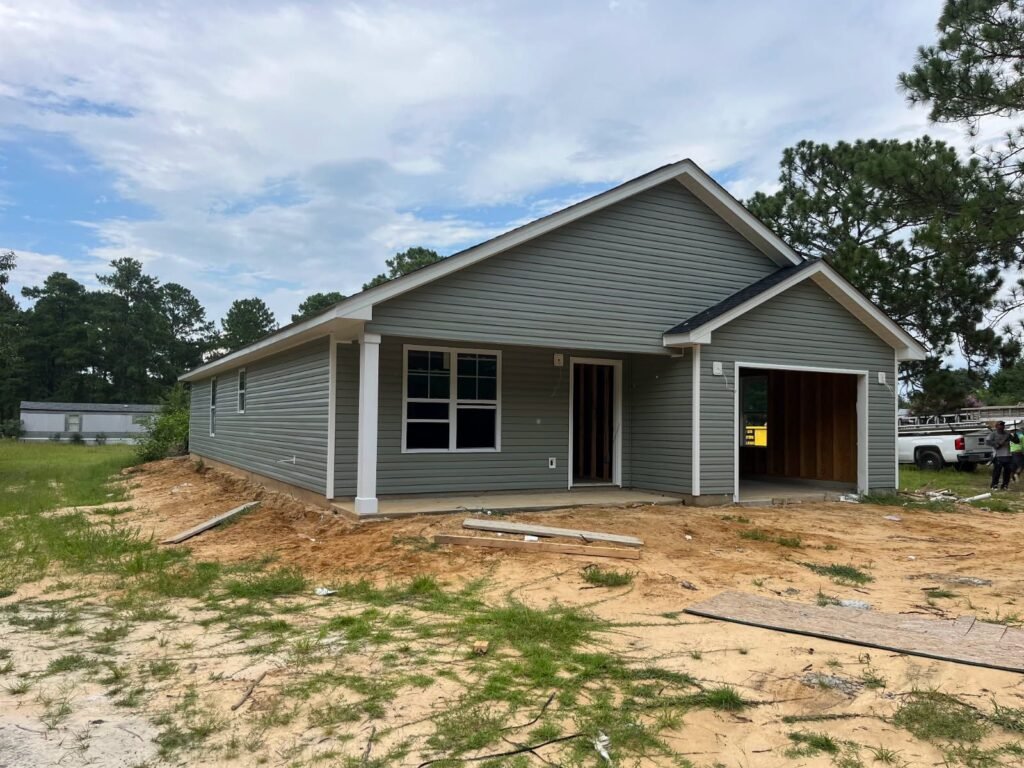
- Three hybrid deals (in Newton, Gastonia, and Durham, NC) that included a house plus additional land for development.
- Two flips with a partner, seizing short-term profit opportunities that made sense in the moment.
That’s the mindset I’ve developed over time:
I never say no on principle — I evaluate every deal. If the upside is there, I go for it.
🌱 The Land-Plus-House Model: Building for the Future
The three hybrid deals were a strategic evolution. The idea was simple:
- Break even on the existing house
- Get the land for free
- Use that land to build and create equity from scratch
This marked my entrance into new construction — something I previously thought was “too advanced” or too risky. But I realized that in many cases, the cost to build new was nearly identical to the cost of buying and renovating an old home. Given that, I’d rather own something brand new with all-new systems than deal with plumbing and HVAC surprises.
💰 Unlocking the Equity Snowball
2024 was also the year I realized I had something powerful: a portfolio full of hidden equity, thanks to appreciation. So I went back to the bank and refinanced again, this time pulling out an additional $120K.
I used that capital to keep growing the portfolio — creating a virtuous cycle:
Buy properties with built-in equity → Let time and appreciation grow your net worth → Harvest that equity → Reinvest into new opportunities
This is how you build wealth — not from a single deal, but from stacking smart moves over time.
🧠 What I Learned in Year 5:
- BRRRR isn’t dead — it just needs the right market and timing
- The best investors stay open. Some years are for flips, some for holds, some for land
- New construction is a calculated risk — but the rewards can be massive
Equity is your engine. Appreciation + refis can fund the next stage of your growth
🏁 Conclusion: 5 Years, $150K, and a Portfolio That Changed My Life
If there’s one reason I was able to turn $150K into a $4 million real estate portfolio, it’s this:
I jumped in.
I didn’t wait to “know everything.” I made a move.
And then I made another.
Did I make mistakes? Absolutely. But every mistake moved me forward. Every deal — good or bad — taught me something I couldn’t have learned from watching YouTube videos or hearing about other people’s real estate investing success stories. I had to create my own.
🔑 What I Learned After 5 Years of Investing:
- Adapt or fall behind. The strategy that worked in 2020 doesn’t work in 2024 — and what works today won’t work in 2029.
- Cash flow pays the bills. Appreciation builds wealth. I was chasing income, but the real lever was equity growth.
- Real estate is a people business. The numbers matter, but the relationships matter more — contractors, wholesalers, lenders, agents. Who you work with shapes your success.
📊 Where Things Stand Today
Over five years, I’ve built a portfolio of:
- 15 total units: 8 I own solo, 7 with partners
- $4 million in total value
- $1.2 million in equity
Right now, I’m letting time and leverage do their thing — appreciation and debt paydown continue to grow my wealth without chasing more deals every month.
🔽 [Insert table: Portfolio Growth Summary]
| Year | Units Owned | Portfolio Value | Capital Invested | Equity Built |
|---|---|---|---|---|
| 2020 | 1 | $150K | $50K | $20K |
| 2021 | 4 | $650K | $100K | $200K |
| 2022 | 6 | $1.1M | $160K | $350K |
| 2023 | 8 | $2.4M | $200K | $700K |
| 2024 | 15 | $4M | $240K | $1.2M |
📈 How It Compared to Stocks
Of course, I could’ve gone the easy route and dumped $150K into the S&P500 in 2020. That would’ve yielded a solid return — but it wouldn’t have come close to this.
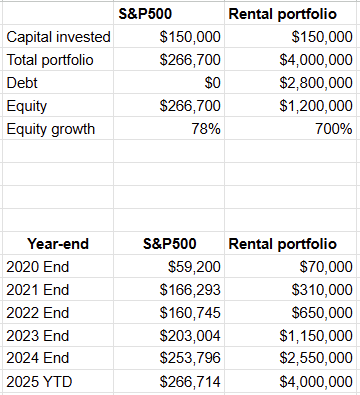
Real estate gave me 10x the equity growth over the same period — plus control, leverage, and skill-building that compounds over time.
💬 Final Thought: Just Go For It
If you’re sitting on $50K or $150K and wondering whether to get into real estate, here’s my advice:
Stop waiting. Start learning by doing.
Pick a market. Talk to people. Make offers.
Don’t aim to be perfect — aim to move.
That’s what I did.
And five years later, I’m here.